- For Some Reason, This Year I Am Bound to Shintoism
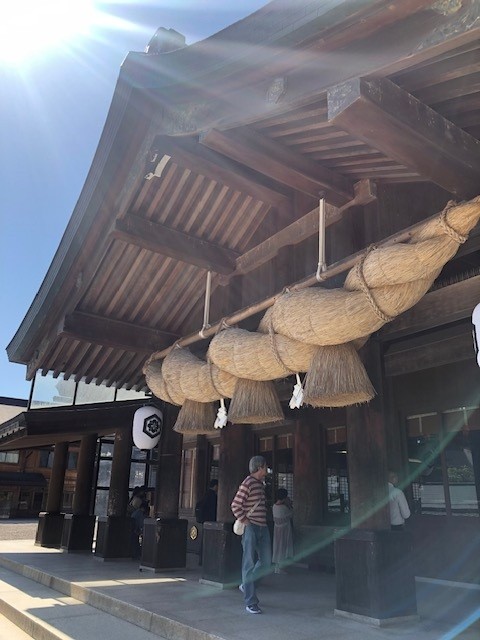
- First, look at the Shimenawa (sacred straw rope) in front of the Kagura-den at Izumo Taisha
- Izumo and Suwa
- This year happens to be the Year of the Snake
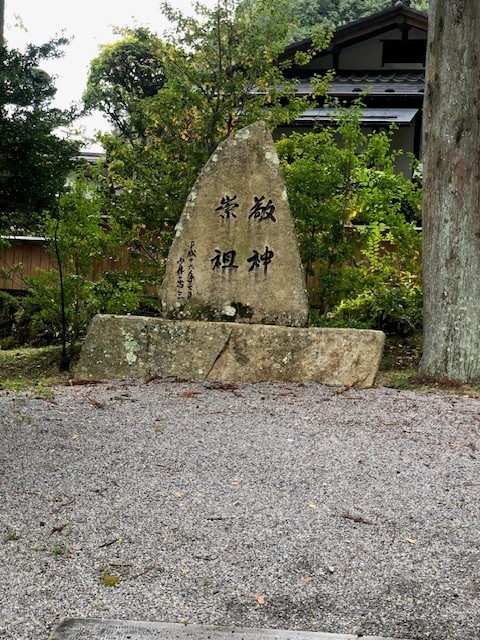
- At the Suwa Kamisha precincts, there is a stone monument inscribed with “Keishin Suso” (Revere the Heavenly Gods, Honor the Ancestral Earthly Gods)
- And finally, the Onbashira(Sacred Pillar)!
For Some Reason, This Year I Am Bound to Shintoism
From Izumo Taisha, Grand Shrine in May to Harumiya(Spring Shrine) and Akimiya(Autumn Shrine) of Suwa Taisha,”Shimo-sha”, in June, Ise Grand Shrine in July, Maemiya (Front Shrine) and Honmachi (Main Shrine / Honmachi) of Suwa Taisha,”Kami-sha” again in October, and finally Abe no Seimei Shrine and Atsuta Jingu in November…
My life has always been one of “praying to the gods for help,” but why have the gods come rushing toward me in such a torrent this year?
Resigned to this fate, I began devouring history books: “Yamato and Izumo“, “The Identity of the Mononobe Clan“, “The Identity of the Fujiwara Clan“, “My Ancient Japanese History” by Masao Ueda, “The Urashima Legend and the Jews“, “The Nation of Japan” by Masao Ueda and Takeshi Umehara, and even “the history of the Jomon period”.
Since I was never good at history, it felt like reviewing a middle school textbook from scratch.
It was fresh and interesting, giving me a sensation we call “kosobayui” in the Kansai dialect—a sort of intellectual “tickling” in the brain.
One thing I cannot stop wondering about is the relationship between Izumo and Suwa.
First, look at the Shimenawa (sacred straw rope) in front of the Kagura-den at Izumo Taisha
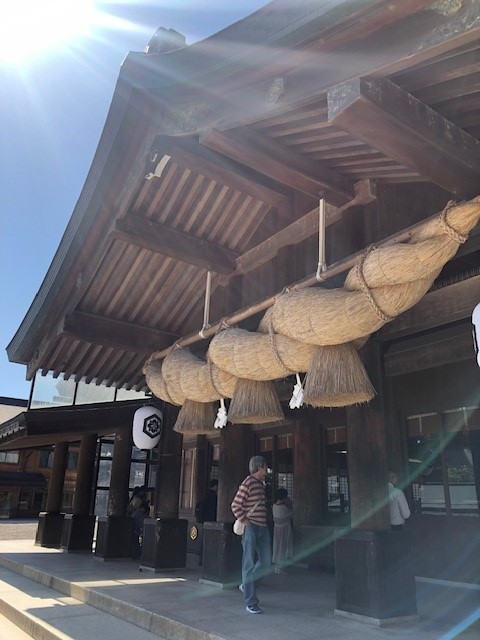
It has a weightiness that makes you think, “If this fell on my head, it would be the end of me.” They say if you toss a coin up and it sticks into the rope’s tassels, good things will happen.
Then, here is the Kagura-den and Shimenawa(sacred straw rope) at Suwa Taisha (Shimo-sha).
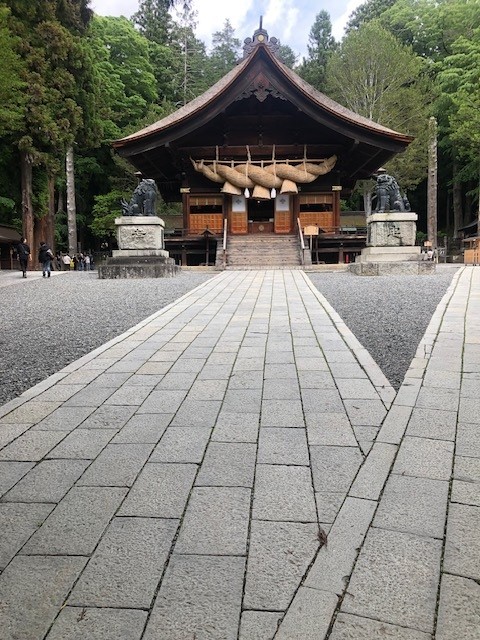
Izumo and Suwa
The similarity between the two is extraordinary. Both feature prominent large shime-nawa sacred ropes.
As I gazed at these immense, heavy objects—wondering if the balance between the rope and the building was even safe—I began to see them not as mere decorations, but as if the ropes themselves were the Goshintai (the body of the deity).
This is not a static form. It twists, entangles, tightens, and leaps up—it is moving with power. To my eyes, it looks like nothing other than snakes intertwining and clinging to the shrine.
This year happens to be the Year of the Snake
Coincidentally, this year is the Year of the Snake. It felt like the pulsation of a snake, a deity of the earth.
Still, the distance between Izumo and Suwa is vast—from the coast of the San’in region to the deep mountains of Shinshu. As I pondered this, I happened upon the Jin cho kan Moriya Historical Museum near Suwa Taisha Kami-sha.
There, the legend was recorded: “Takeminakata, who came to Suwa from Izumo, subdued the local earthly deities.” Although there were as many as fifteen local gods, a clan called Moriya, who served the gods, became the “kami naga” (head of the gods) and unified them, eventually accepting Takeminakata as the Great God of Suwa.
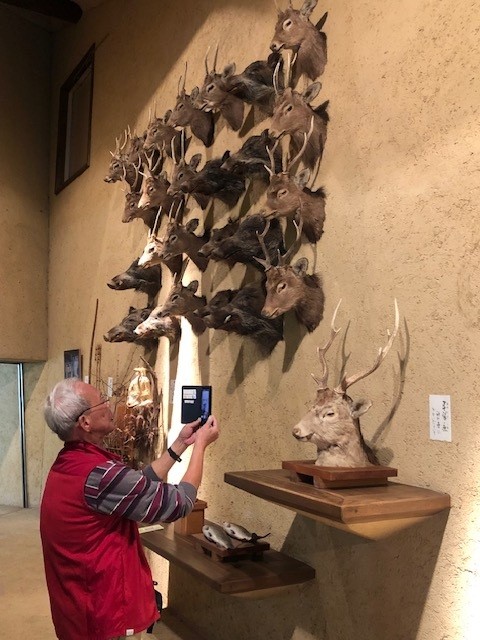
To honor the god of Suwa, many offerings were made, with deer skins being particularly important. Inside the museum, rows of deer heads lined the walls.
From my recent readings, I learned that at Izumo, a deity of the Yamato-Amaterasu lineage named “Takemikazuchi” descended and drove out “Takeminakata,” the powerful local god of Izumo. Because this displacement caused various calamities, it was decided that the earthly god must be revered, leading to the creation of the Grand Shrine.
So, is there a shared mythological structure between Izumo and Suwa—a story of gods driving others out and being driven out themselves? Is that where the connection lies?
Perhaps it is just the guesswork of a history amateur…
At the Suwa Kamisha precincts, there is a stone monument inscribed with “Keishin Suso” (Revere the Heavenly Gods, Honor the Ancestral Earthly Gods)
It can be read as a message to respect the heavenly gods who descended, while also honoring the ancestral gods who were there from the beginning.
And finally, the Onbashira(Sacred Pillar)!
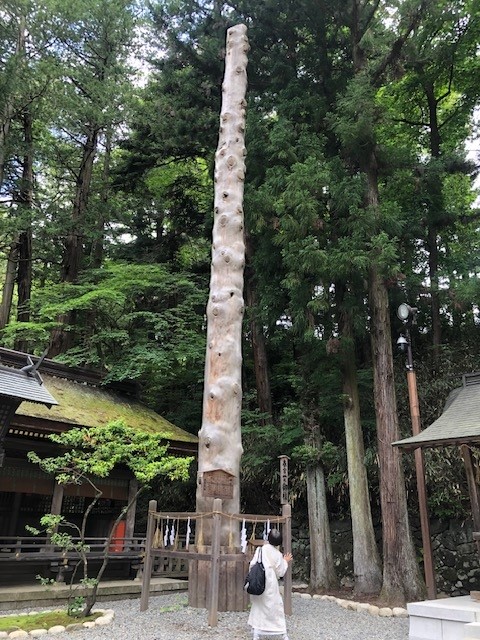
Every seven years, brave men and women cling to these massive logs, dragging them down the mountains to set them in this very spot within the shrine grounds.
Is this the form of an earthly god reaching toward the sky? Or is it a vessel for a heavenly god to descend upon?
What do you all think?
Respectfully, Nonaka



コメント